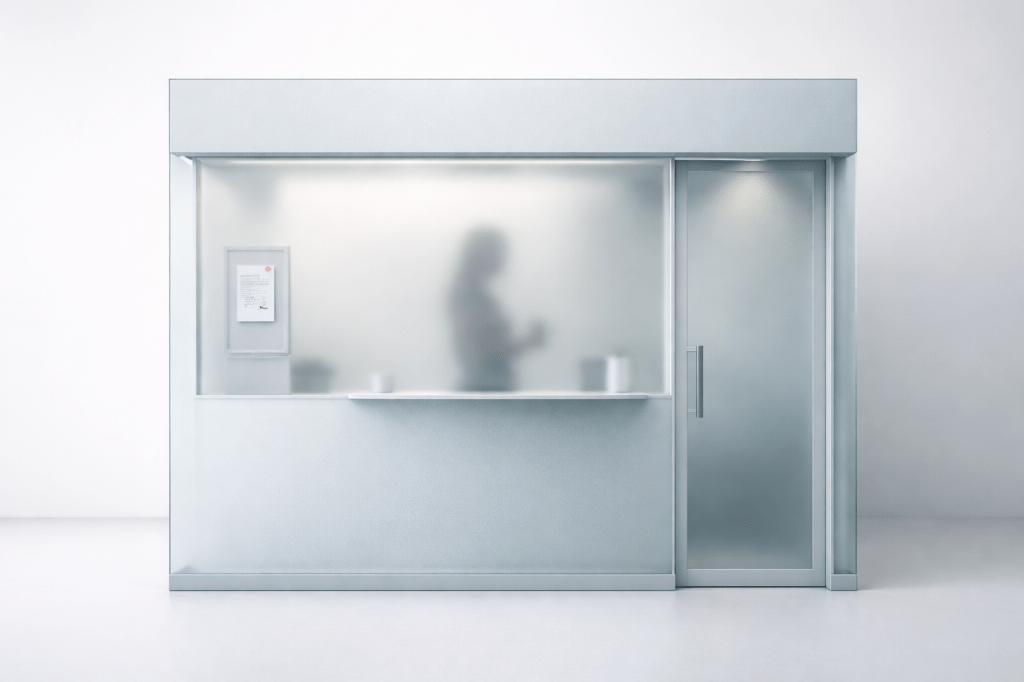
The kiosk was made of frosted glass.
You could see the outline of the person inside.
A shape moving.
Hands arranging something.
A silhouette leaning forward when someone approached.
From the outside, it felt safe.
Contained.
Orderly.
She worked inside it.
People came up to the small opening at the counter.
Ordered what they needed.
Exchanged a few polite words.
Moved on.
She smiled.
Delivered what was asked for.
Stayed efficient.
Through the glass, she could see them too.
Their gestures.
Their posture.
The way some lingered, and some left quickly.
The glass softened everything.
No one saw the full expression on her face.
No one quite read her eyes.
No one knew when she was tired, or unsure, or quietly wanting more than transactions.
Sometimes she posted a notice on the outside of the kiosk.
A thoughtful line.
A reflection.
A glimpse of something real.
People would stop.
Read it.
Nod.
Even comment on it.
Then they would move on.
The frosted glass remained.
It meant she could interact without being fully exposed.
She could offer something of herself without stepping out from behind the barrier.
She could be visible and still protected.
It worked.
Until she noticed that even when someone stood there longer…
even when a conversation deepened…
even when laughter came easily…
They still walked away.
They never came inside.
They never saw her clearly.
And she began to wonder whether the kiosk had been built for safety
or whether she had chosen it
because clarity felt too risky.
The glass had never been locked.
There had always been a door at the side.
She simply had not opened it.
Because once you step out from behind frosted glass,
you cannot control how clearly you are seen.
And she was no longer sure
which frightened her more,
being unseen
or being known.
 The Next Chapter Room
I’d love to hear your thoughts, feel free to share in the comments.